Directory
Species on the edge
A curated set from the public IUCN Red List — not all 49,505 threatened species, the ones whose stories we can actually sit with. Watch any of them. The list is the point.
34 species
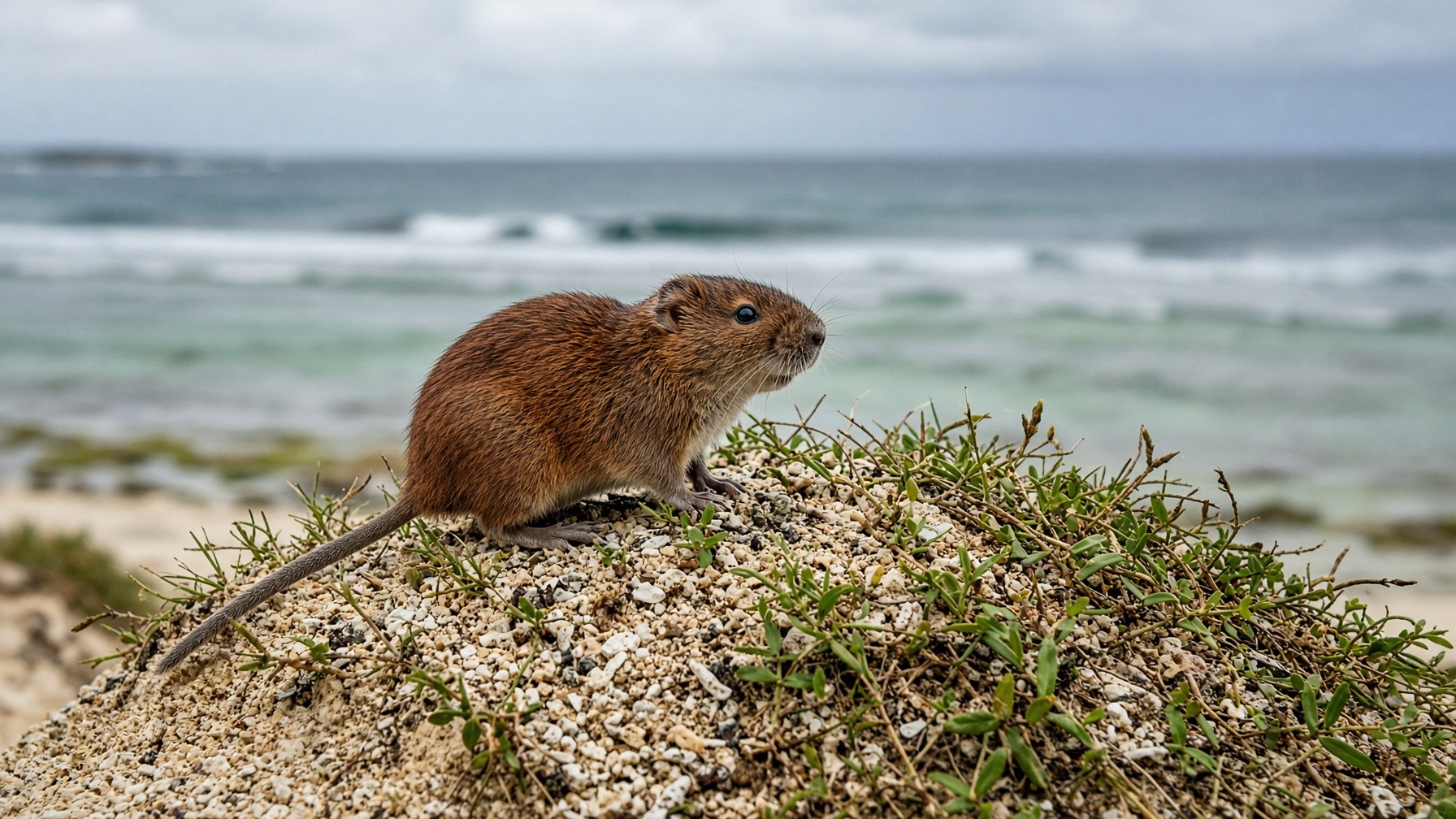
Bramble Cay melomys
Melomys rubicola
The first documented mammal extinction driven primarily by human-caused climate change. A small rodent on a small cay, erased by water.

Golden toad
Incilius periglenes
Bright orange, abundant, then gone in a handful of seasons. A warning shot for the global amphibian collapse.

Passenger pigeon
Ectopistes migratorius
Once the most abundant bird in North America — flocks that darkened the sky. Billions to zero in a century. The scorecard’s wildlife F is not a metaphor. This is the exhibit.

Slender-billed curlew
Numenius tenuirostris
Declared extinct in 2025 — the first global bird extinction in mainland Eurasia and Africa in recent centuries. Thirty years of searching after the last photograph did not produce another bird.

Western black rhinoceros
Diceros bicornis longipes
A subspecies hunted out after surveys in Cameroon found none. The horn trade did not need a whole species. It took a unique lineage and left the others hanging on.

Addax
Addax nasomaculatus
A desert antelope built for places with no water. Civil conflict and oil tracks opened the last range to hunters.

African forest elephant
Loxodonta cyclotis
Split from the savanna elephant and listed as Critically Endangered in 2021. A gardener of the Congo forest — seeds do not plant themselves.

Amur leopard
Panthera pardus orientalis
The rarest big cat. Camera traps in Land of the Leopard National Park show a slow climb from a few dozen animals — proof that a park with rangers is not a metaphor.

Axolotl
Ambystoma mexicanum
Famous in tanks, nearly gone in the only lake it belongs to. Captive abundance is not a wild population.

Black rhinoceros
Diceros bicornis
Still critically endangered, and also one of conservation’s real comebacks. Intense anti-poaching and translocations pulled it off the floor.

Cotton-top tamarin
Saguinus oedipus
A half-pound primate with a white punk crest, found nowhere else on Earth. Colombia’s dry forest has been cut to a remnant, and tens of thousands of tamarins were exported for labs and the pet trade in the last century.

Cross River gorilla
Gorilla gorilla diehli
The rarest gorilla. Small groups persist on forested hills that hunting trails still reach.

Gharial
Gavialis gangeticus
A fish-eating crocodile with a ghara on the snout. Reintroduction is working in a handful of rivers; most of the historic range is empty.

Hawksbill sea turtle
Eretmochelys imbricata
Hunted for jewelry. The shell is still sold, legally in some places, illegally in most.

Javan rhinoceros
Rhinoceros sondaicus
The entire species lives in one coastal park next to a volcano. There is no backup population. A wave, a disease, or one determined poacher could end the line.

Kakapo
Strigops habroptilus
A nocturnal, flightless parrot pulled from the edge by a country that decided one species was worth a national project. Every bird has a name.

Northern white rhinoceros
Ceratotherium simum cottoni
Functionally extinct in the wild. The last male, Sudan, died in 2018. Scientists are attempting IVF with southern white rhino surrogates — a last-ditch technology for a subspecies we did not protect in time.

Philippine eagle
Pithecophaga jefferyi
One of the world’s largest eagles, tied to forest that keeps being cut. Each pair needs a huge territory.

Saola
Pseudoryx nghetinhensis
Discovered by science in 1992, already sliding out of it. Camera-trap photos are rare; no saola has been seen by a biologist in the wild for years.

Siamese crocodile
Crocodylus siamensis
Almost gone from the wild while abundant in crocodile farms — often hybridised, so the farm is not a ark.

Sumatran orangutan
Pongo abelii
A great ape losing forest faster than it can reproduce. Females have a single infant every 7–9 years. That math does not survive a plantation.

Sumatran tiger
Panthera tigris sumatrae
The last island tiger. Bali and Java’s tigers are already gone.

Vaquita
Phocoena sinus
The world’s smallest porpoise, and the most endangered marine mammal. 2025 surveys found animals still reproducing inside the Zero Tolerance Area — the collapse slowed, it did not reverse.

Yangtze finless porpoise
Neophocaena asiaeorientalis
The only porpoise in a river. Its cousin, the baiji, is already gone. A 2022 census showed the first increase in decades after fishing bans.

Blue whale
Balaenoptera musculus
The largest animal that has ever lived. Whaling nearly ended it. Some populations are climbing; others have not returned.

Chimpanzee
Pan troglodytes
Our closest living relative, listed Endangered. Four subspecies, all going the wrong way.

Green sea turtle
Chelonia mydas
A mixed ledger: legal protection and nest programs have brought some beaches back; others are still emptied every season.

Mountain gorilla
Gorilla beringei beringei
Downlisted from CR to EN in 2018 after habituation-based tourism funded ranger protection. Still endangered. Still the best great-ape recovery story we have.

Red panda
Ailurus fulgens
Not a panda, not a raccoon. A forest specialist whose bamboo understory is being cleared from under it.

Whale shark
Rhincodon typus
The largest fish. Slow, surface-feeding, easy to hit with a hull.

Giant panda
Ailuropoda melanoleuca
Downlisted from Endangered to Vulnerable in 2016 after decades of reserve expansion. Still not safe — bamboo is a specialist diet in a warming mountain range.

Iberian lynx
Lynx pardinus
From 62 mature animals in 2001 to more than 2,000 today. IUCN downlisted it from Endangered to Vulnerable in June 2024 — one of the clearest large-carnivore recoveries on record.

Polar bear
Ursus maritimus
A climate species, listed as Vulnerable because the ice it hunts from is a season that keeps shrinking.

Snow leopard
Panthera uncia
Downlisted to Vulnerable in 2017 — a data correction as much as a recovery. The cat is still in trouble; we just counted better.